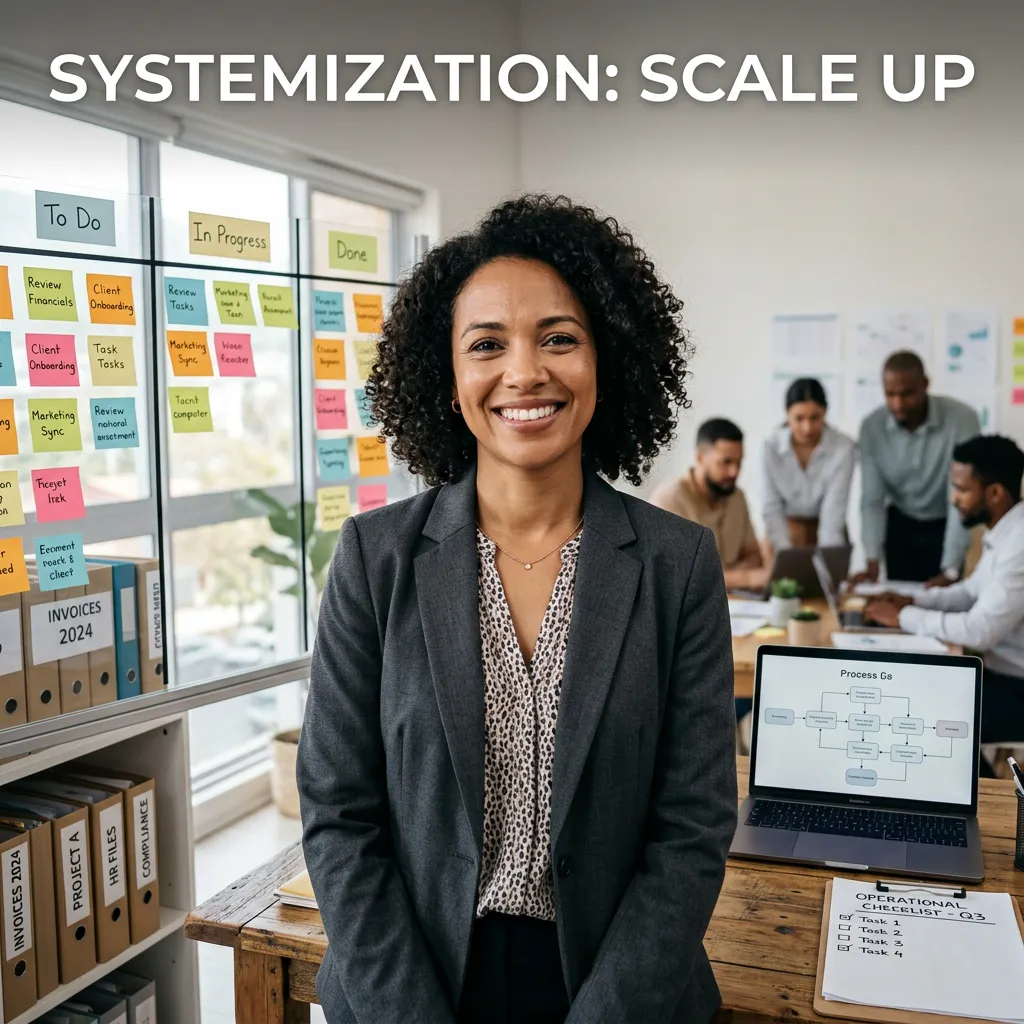
Systemization: Key to Scaling Small Businesses
Small Business, Systemization, Business Processes
Why Systemization Is the Secret to Scaling Your Small Business
If you want to systemize small business operations so you can grow without burning out, you are not alone. Many entrepreneurs in Nigeria and across Africa discover the hard way that passion and hustle are not enough. Growth without Systemization quickly turns into chaos-missed orders, confused staff, and customers who quietly disappear. This article unpacks why business systemization is the real secret to Small Business Growth, and how you can start building scalable business processes today.
Growth and Chaos Are Not the Same Thing
Many entrepreneurs equate busyness with success. The phones are ringing, WhatsApp messages are buzzing, staff are running around, and the bank alerts are coming in. On the surface, it looks like you have finally managed to Scale Business operations. But underneath, there is confusion: orders are lost, promises are forgotten, and every small mistake lands on your desk. That is not sustainable Small Business Growth; that is unmanaged complexity.
Growth without Systems usually feels like this:
You spend evenings fixing problems that should never have happened in the first place.
Customers get different experiences depending on who attends to them that day.
Staff wait for you to approve every small decision, slowing everything down.
Important tasks live in your head or in random chats, not in a clear system.
Over time, this chaos silently kills Business Efficiency. You lose money through rework, refunds, delays, and staff turnover. You cannot take a week off without everything falling apart. According to research from the U.S. Small Business Administration, one of the biggest obstacles to scaling is the lack of structured processes and systems that can support growth.
📌 Key Takeaway: Revenue growth without clear business processes is just organized chaos. Real scaling requires structure.
What Systemization Really Means
Systemization is the deliberate act of turning the way your business works into clear, documented, repeatable steps. Instead of “how we do things” living inside your head or inside one staff member’s memory, you create visible Process Documentation that anyone on your team can follow and improve over time. When you systemize small business activities, you move from personality-driven operations to process-driven operations.
At its core, business systemization covers three layers:
Documented Workflows: Step-by-step guides for recurring tasks like onboarding a client, fulfilling an order, or handling a complaint.
Defined Roles and Responsibilities: Clarity on who does what, by when, and to what standard of quality.
Supporting Tools and Automation: Simple tools and software that ensure the process runs the same way every time, with minimal manual effort.
For entrepreneurs who want to scale small business Nigeria, this approach is especially powerful. With Systemization, you can hire and train new staff faster, deliver consistent service across branches, and maintain quality even as demand increases. Instead of starting from scratch each time, your team follows proven business processes that already work.
💡 Pro Tip: Start by documenting what already works. You do not need perfect systems on day one; you just need your current best way written down.
If you are curious about how automation supports Systemization, explore our guide on Business Automation 101 to see how technology can execute parts of your process for you.
The Founder Bottleneck Problem
One of the biggest barriers to Business Efficiency is the Founder Bottleneck. In many growing companies, the founder is the smartest problem-solver, the best salesperson, and the only person who understands how everything connects. That sounds impressive, but it quietly limits your ability to Scale Business.
You know you are facing a Founder Bottleneck when:
Every decision, no matter how small, comes back to you for approval.
Sales slow down when you are not personally involved in every deal.
Staff are afraid to make decisions because they are not sure what “right” looks like.
You cannot step away for a few days without operations stalling or collapsing.

-toned scene of a Nigerian founder at a crowded desk juggling phone calls laptop messages and...
When every decision routes through the founder, growth slows and stress explodes.
The uncomfortable truth is this: if your business cannot run without you, it is not really a scalable business yet-it is a demanding job with staff. Business systemization is how you escape this trap. By creating clear Process Documentation, you transfer knowledge from your head into systems your team can follow. You move from “ask the founder” to “follow the process.”
📌 Key Takeaway: The Founder Bottleneck disappears when your people rely on systems, not on your memory or presence.
Systems That Scale vs. Systems That Break
Not all systems are created equal. Some work beautifully when your team is small but collapse under pressure as you add more staff, more customers, or more locations. To truly scale small business Nigeria, you need systems designed with growth in mind from the start.
Systems that break usually have these characteristics:
They depend on one “superstar” employee who holds all the knowledge.
They are stored only in people’s heads or in long chats, not in clear documents.
They require constant manual follow-up, reminders, and micro-management.
They are too complex, with many exceptions and “special cases” that confuse staff.
In contrast, systems that scale share a different set of traits:
They are simple enough for a new hire to understand quickly, yet detailed enough to reduce mistakes.
They are documented visually, using checklists, flowcharts, or templates-so there is one source of truth.
They build in automation where it makes sense, reducing repetitive manual work.
They are regularly reviewed and improved based on feedback and performance data.
💡 Pro Tip: If a system only works when your “best person” is on duty, it is not yet a scalable system. Aim for processes that work on an average day with average staff.
At KD Squares, we have seen this transformation repeatedly in our client work. You can explore our services on our KD Squares services page, where small businesses share how Systemization helped them stabilize operations and grow with confidence.
How to Know You're Ready to Systemize
Many founders assume that business systemization is only for big companies with departments and complex structures. In reality, the best time to systemize small business operations is when you start feeling the strain of growth-but before it turns into full chaos. Here are clear signs you are ready:
You are turning away customers or delaying projects because your team is overwhelmed.
Quality is inconsistent-some days are excellent, others are full of mistakes.
You have hired new staff, but they take too long to become productive because nothing is documented.
You feel stuck in day-to-day operations and rarely have time for strategy and innovation.
If these points describe your situation, you are not failing; you are simply operating without the systems that your current level of Small Business Growth now requires. The next step is to start building scalable systems in a structured way.
A Simple Framework to Build Scalable Systems
Here is a practical starting framework you can use to build systems that support long-term growth:
Identify Your Critical Processes: List the 5–10 activities that drive revenue and customer experience- sales, onboarding, delivery, support, and collections. These are your first targets for Process Documentation.
Map the Current Reality: For each activity, write out the exact steps as they happen today. Who does what? In what order? Using which tools? Be honest; you are documenting reality, not your ideal.
Simplify and Standardize: Remove unnecessary steps, clarify handovers, and define quality standards. Turn the process into checklists, templates, and clear instructions your team can follow every time.
Add Automation Where It Helps: Use simple tools- like CRMs, invoicing software, or workflow apps, to automate repetitive tasks and reminders. Our Business Automation 101 guide explains how to choose the right tools for your stage of growth.
Train, Test, and Improve: Roll out the new system with your team, gather feedback, and refine it. Good systems evolve; they are not a one-time project but an ongoing discipline.
📌 Key Takeaway: You do not need to systemize everything at once. Start with your most painful or most profitable processes and build from there.
Ready to Systemize and Scale Your Business?
For ambitious founders who want to scale small business Nigeria and beyond, Systemization is not a luxury, it is the foundation of sustainable Small Business Growth. When you treat your company as a collection of well-designed business processes instead of a collection of busy people, everything changes. Quality improves, stress reduces, and your role as founder shifts from firefighter to architect.
KD Squares specializes in helping small businesses document, automate, and optimize their operations so they can truly scale their business without losing control. Whether you are battling the Founder Bottleneck or simply tired of running the same manual tasks every day, we can help you design systems that work in the real world, right here in Nigeria’s fast-moving business environment.
If you are ready to turn chaos into clarity and build the systems your growth deserves, talk to KD Squares today about systemizing your business for growth. Reach out to us to schedule a consultation, and let us design the business systemization roadmap that will carry your company to its next level.
