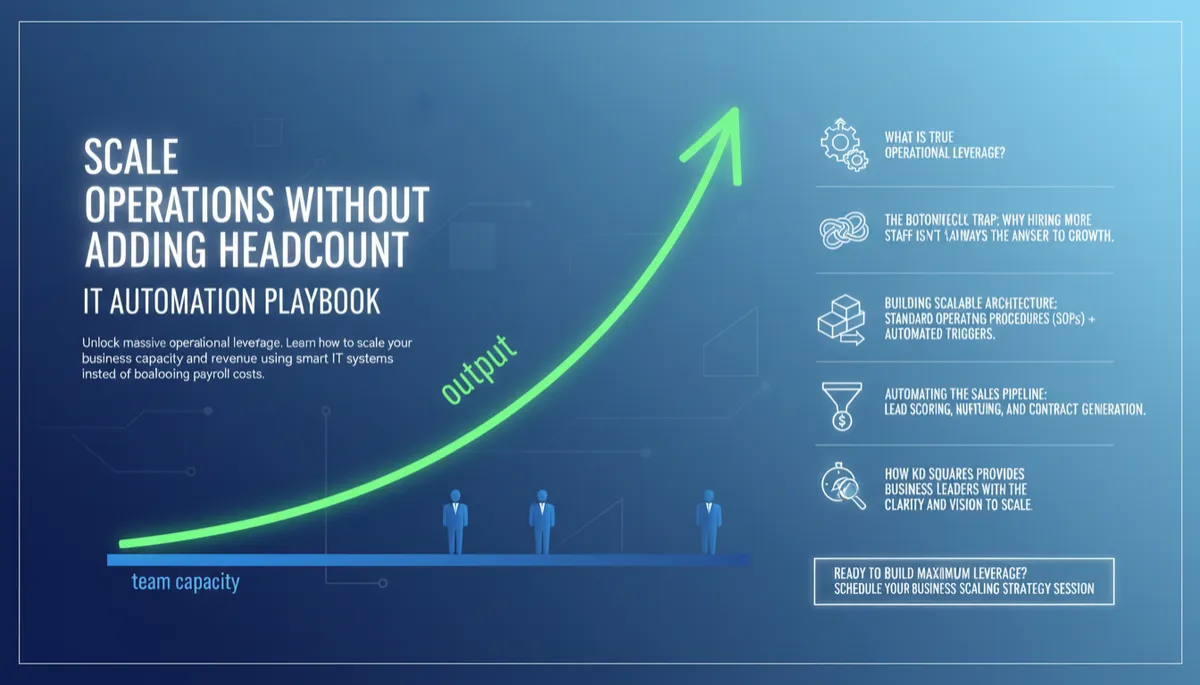
Scale Operations with IT Automation Playbook
IT Automation, Operational Efficiency, Scalable Solutions, Business Growth Strategies
Scaling Operations Without Inflating Headcount: The IT Automation Playbook
Every ambitious business hits the same wall: demand is growing, customers want more, and your team is already stretched. The traditional answer is simple, hire more people. Yet adding headcount also adds complexity, payroll costs, and managerial overhead, often eroding the very margins you are trying to grow. That is where IT Automation and scalable solutions become your most powerful business growth strategies.
This IT Automation Playbook will show you how to scale capacity, revenue, and consistency using automation tools and system design, not just more people. We will unpack what true operational leverage looks like, why hiring alone can trap you, and how to build a scalable architecture from SOPs to automated triggers and a fully orchestrated sales pipeline. Finally, you will see how KD Squares helps leaders gain the clarity and vision to execute cost-effective scaling with confidence.
What Is True Operational Leverage?
Most leaders talk about “working smarter, not harder,” but true operational leverage has a very specific meaning: it is the ability to increase output, revenue, and impact without increasing input, especially human hours at the same rate. In other words, your business can handle more customers, more transactions, and more complexity while your team size grows slowly, or even stays flat, because IT Automation and systems carry the load.
True operational leverage shows up in three ways:
Throughput rises faster than payroll: You can process more orders, onboard more clients, or run more campaigns without a proportional spike in salaries and benefits.
Quality becomes more consistent: Automated workflows reduce human error and variance, making your operations more predictable and reliable.
Leaders regain strategic time: Instead of chasing fires, leadership can focus on business growth strategies;new markets, partnerships, and products.
Achieving this kind of leverage is not about one magic tool. It is about designing scalable solutions where technology, data, and process work together. When your core processes are encoded into automation tools, your business becomes inherently more scalable and dramatically more cost-effective.
The Bottleneck Trap: Why Hiring More Staff Isn't Always the Answer to Growth
When growth hits, the reflexive response is to post a job ad. But relying solely on headcount to solve operational challenges creates what we can call the bottleneck trap. You add people to relieve pressure, but each new hire adds training needs, communication overhead, and coordination complexity. Over time, the organization becomes slower, not faster.
Common signs you are in the bottleneck trap include:
Projects stall waiting for approvals, data, or decisions from a few “indispensable” people.
New hires shadow veterans for months because processes only exist in people's heads, not in systems.
Leaders feel like they are paying more every quarter, but still fighting the same operational fires.
This is where IT Automation changes the game. Instead of asking, “Who do we need to hire?” the better question is, “What can we automate, standardize, or eliminate?” With the right automation tools, many recurring tasks; data entry, notifications, approvals, document generation can be handled by systems, allowing your existing team to focus on higher-value work that truly moves the needle.
📌 Key Takeaway: If your first instinct is to hire, pause and map the workflow. You will often find opportunities for cost-effective scaling through automation before you add more people.
Building Scalable Architecture: Standard Operating Procedures (SOPs) + Automated Triggers
Operational excellence starts with clarity. Before you can automate, you need to know exactly what should happen, when, and in what order. That is where Standard Operating Procedures (SOPs) meet IT Automation. Together, they form the backbone of a truly scalable architecture.
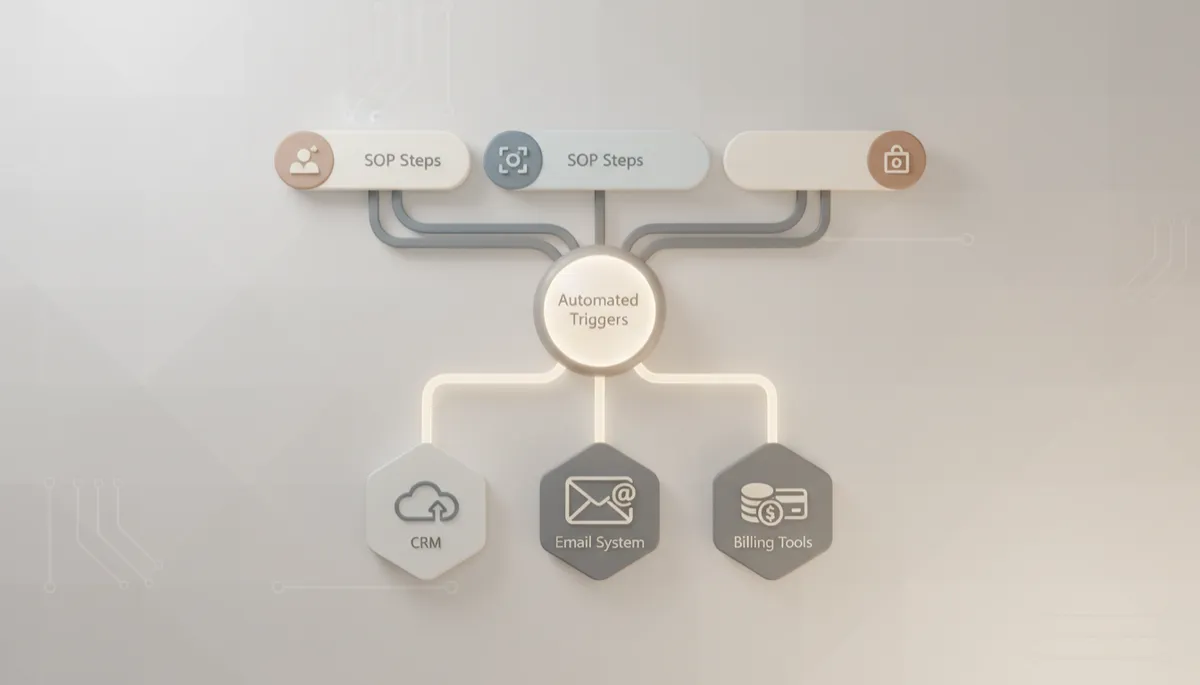
Documented SOPs plus automated triggers turn ad-hoc work into repeatable, scalable workflows.
A practical approach looks like this:
Document the ideal workflow: Capture each step in a concise SOP; who does what, using which tools, and what “done” looks like. This alone improves operational efficiency.
Identify trigger points: Look for moments that can automatically start the next step; a form submission, a payment received, a status change in your CRM, or a time-based event.
Connect systems with automation tools: Use scalable solutions such as workflow engines, integration platforms, or CRM automations to pass data between tools and kick off tasks without human intervention.
Monitor and refine: Track cycle times, error rates, and handoffs. Adjust your SOPs and automations to continuously improve operational efficiency.
The result is a business where repeating processes no longer rely on memory or heroics. Instead, your SOPs define the standard, and your IT Automation executes it consistently at scale, delivering cost-effective scaling that feels almost effortless once set up.
Automating the Sales Pipeline: Lead Scoring, Nurturing, and Contract Generation
If there is one area where IT Automation delivers immediate ROI, it is your sales pipeline. Many teams still manage leads manually; copying data between spreadsheets, sending ad-hoc follow-ups, and generating contracts one-by-one. This not only slows growth, it also creates an inconsistent experience for prospects. By contrast, an automated pipeline becomes a powerful business growth strategy in itself.
Intelligent Lead Scoring
With the right automation tools, every new lead can be automatically scored based on demographics, behavior, and engagement. Website visits, email opens, content downloads, and form responses all feed into a dynamic score. High-scoring leads are routed directly to sales, while others enter nurturing sequences, ensuring your team focuses on the highest-value opportunities without manually sorting through lists.
Automated Nurturing Journeys
Instead of one-size-fits-all blasts, IT Automation allows you to design personalized nurturing journeys. Based on a prospect's profile and actions, your system can send tailored content, reminders, and offers. Automation ensures every prospect hears from you at the right time, with the right message, without requiring your team to manually track dozens of touchpoints. This kind of scalable solution is central to modern business growth strategies.
Frictionless Contract Generation and Handoffs
Once a deal is ready to close, automation can handle the heavy lifting. Proposal templates, pricing tables, and legal clauses can be merged automatically into contracts based on deal data in your CRM. E-signature tools can trigger notifications, update deal stages, and even kick off onboarding workflows the moment a contract is signed. This is cost-effective scaling at its best: you close more deals, faster, without hiring a small army of coordinators.
💡 Pro Tip: Start by automating the "boring middle" of your sales process; data entry, follow-up reminders, and document creation. These are high-volume, low-complexity tasks perfect for IT Automation.
How KD Squares Provides Business Leaders with the Clarity and Vision to Scale
Technology alone does not create leverage, strategy does. Many organizations invest in automation tools but never realize full value because they lack a clear roadmap. KD Squares bridges that gap by helping business leaders design scalable solutions that align IT Automation with their growth ambitions and operational realities.
Working with KD Squares typically involves three key dimensions:
Strategic Clarity: Mapping where your business is today, where you want it to be, and how IT Automation can close the gap. This includes identifying bottlenecks, hidden manual work, and opportunities for cost-effective scaling.
Process and Architecture Design: Turning tribal knowledge into documented SOPs, then designing automated workflows and integrations that support your long-term business growth strategies.
Implementation and Iteration: Selecting the right automation tools, configuring them to your environment, and refining them based on real-world performance and feedback from your team.
The outcome is a business that no longer fears growth spurts or seasonal spikes. Instead, your systems absorb the extra volume, your team works from a place of focus rather than frenzy, and leadership has the visibility to make confident decisions. That is the essence of operational efficiency powered by intentional IT Automation.
Ready to Build Maximum Leverage?
Scaling no longer has to mean spiraling payroll, endless hiring cycles, and burnt-out teams. By embracing IT Automation, documenting robust SOPs, and designing scalable solutions around your most critical workflows, you can unlock a new level of operational efficiency. Your business becomes capable of handling more customers, more revenue, and more complexity, while your headcount grows slowly and intentionally, not reactively.
Whether you are looking to automate your sales pipeline, streamline service delivery, or build an architecture that supports long-term business growth strategies, the next move is to step back, design thoughtfully, and implement with purpose. That is where expert partners like KD Squares can help you move faster, avoid common pitfalls, and realize the full promise of cost-effective scaling.
Ready to build maximum leverage? Schedule your business scaling strategy session with KD Squares.
