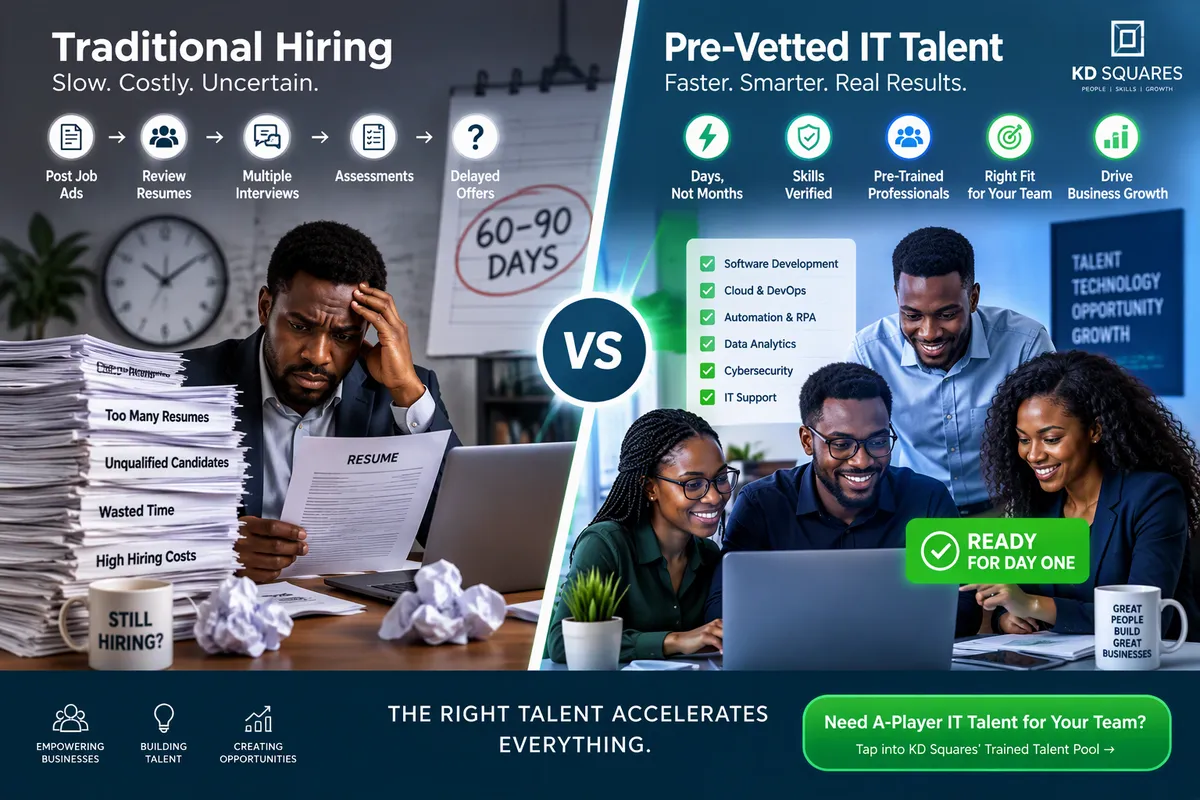
The Fast Track to Hiring Top IT Talent
Sourcing Top IT Talent: Why Traditional Hiring Is Broken for Growing SMBs

Growing a business today without strong technology talent is like trying to scale a company without electricity. Whether you're implementing automation, strengthening cybersecurity, building software products, managing cloud infrastructure, or optimizing operations with data, technology has become the backbone of business growth.
Yet for many small and medium-sized businesses (SMBs), finding the right IT professionals remains one of the most frustrating and expensive challenges they face.
A position is advertised. Hundreds of resumes pour in. Weeks are spent screening candidates. Multiple interview rounds follow. Technical assessments are conducted. Negotiations begin. Then, after months of effort, the selected candidate either declines the offer, accepts another role, or struggles to perform after onboarding.
The traditional hiring process was designed for a different era. Today, businesses operate in a fast-moving digital environment where vacancies create delays, lost productivity, missed opportunities, and increased pressure on existing teams.
This is why more organizations are moving toward a skills-first talent model and choosing to hire pre-vetted IT talent rather than relying exclusively on conventional recruitment methods.
In this article, we'll explore the challenges SMBs face when sourcing technical professionals, the hidden costs of hiring mistakes, and how KD Squares Talent Sourcing helps businesses gain access to highly trained technology professionals who are ready to contribute from day one.
The Challenges Small Businesses Face When Sourcing IT Talent
Finding exceptional technology talent has never been easy. For SMBs, the challenge is often multiplied by budget constraints, limited HR resources, and intense competition from larger organizations.
Competition Against Bigger Employers
Large corporations often have stronger employer brands, larger compensation packages, and extensive benefits programs.
When talented developers, automation specialists, cloud engineers, cybersecurity analysts, or IT support professionals enter the job market, enterprise companies are usually the first to attract their attention.
Small businesses are left competing for the same talent pool with fewer resources and less visibility.
Too Many Resumes, Too Few Qualified Candidates
Job boards can generate hundreds of applications within days. While this may seem beneficial, the reality is that quantity rarely translates to quality.
Many applicants exaggerate their skills, list technologies they have minimal experience with, or present generic resumes optimized for applicant tracking systems.
As a result, hiring managers spend countless hours reviewing applications that do not match the actual requirements of the role.
Increasing Complexity of Technical Roles
Technology roles continue to evolve rapidly.
Today's organizations may require expertise in:
Cloud computing
Automation platforms
Artificial intelligence tools
Data analytics
DevOps processes
Cybersecurity frameworks
Low-code development
Enterprise software integration
Screening candidates for these specialized skill sets requires technical expertise that many internal HR teams simply do not possess.
Extended Hiring Cycles
Traditional hiring processes frequently stretch across several months.
By the time interviews are completed and decisions are made, top candidates have often accepted opportunities elsewhere.
Meanwhile, business projects remain delayed and productivity suffers.
This is why organizations increasingly seek IT staffing solutions for SMBs that can significantly reduce hiring timelines while improving candidate quality.
The Real Cost of Mis-Hires in Technical and Automation Roles
Most businesses understand that hiring mistakes are costly. However, the true impact of a mis-hire often extends far beyond salary expenses.
Financial Costs
A poor hiring decision creates multiple layers of expenditure, including:
Recruitment advertising costs
Interview and screening expenses
Onboarding investments
Training resources
Lost productivity
Replacement hiring efforts
Each unsuccessful hire represents weeks or months of wasted investment.
Project Delays
Technical professionals frequently manage mission-critical projects.
A mis-hire in an automation, software development, or IT infrastructure role can delay system implementations, product launches, operational improvements, and digital transformation initiatives.
These delays often affect revenue growth and customer experience.
Team Morale and Productivity
One poorly matched employee can place significant pressure on an entire team.
When technical deliverables are missed or quality standards are not met, other employees are forced to compensate. This can result in stress, burnout, and reduced morale among high-performing team members.
Security and Operational Risks
In technology-focused roles, performance issues may introduce operational vulnerabilities.
Mistakes involving cybersecurity configurations, cloud infrastructure, automation systems, or software deployment processes can create risks that extend throughout an organization.
For growing businesses, these risks make accurate talent selection more important than ever.
Skills-First Vetting vs. Resume Screening: What Actually Predicts Performance?
For decades, hiring decisions have been heavily influenced by resumes.
The problem is simple: resumes describe experience, but they do not always prove competence.
The Limitations of Resume-Based Hiring
A resume can tell you:
Where someone worked
Which tools they claim to know
How long they've held previous roles
Their educational background
What it cannot reliably tell you is whether the candidate can perform effectively in your specific environment.
Technical hiring requires deeper validation.
Why Skills Matter More Than Credentials
High-performing technology professionals demonstrate capability through practical application.
The best indicators of future success often include:
Technical assessments
Project portfolios
Problem-solving exercises
Scenario-based evaluations
Communication skills
Adaptability
Learning agility
Companies increasingly recognize that proven skill sets deliver greater value than credentials alone.
The Rise of Skills-Based Hiring
Organizations around the world are shifting toward skills-first hiring models.
Rather than focusing exclusively on degrees or years of experience, they evaluate a candidate's ability to solve real business problems.
This approach produces stronger hiring outcomes because it aligns selection criteria with actual job performance.
Businesses looking to hire pre-vetted IT talent benefit from this model because candidates have already demonstrated their technical capabilities before entering the hiring pipeline.
How KD Squares Trains, Vets, and Sources High-Performing IT Professionals
One of the biggest weaknesses in traditional hiring is that employers assume responsibility for assessing, training, and validating talent during recruitment.
KD Squares Talent Sourcing addresses this challenge by creating a pipeline of professionals who are rigorously trained and thoroughly evaluated before being introduced to employers.
Comprehensive Technical Training
KD Squares develops technology professionals through structured, industry-relevant training programs.
Participants receive practical exposure to:
Software development
IT support systems
Automation tools
Cloud technologies
Data management
Business process optimization
Digital transformation methodologies
Training focuses on real-world business applications rather than purely theoretical knowledge.
Rigorous Skills Validation
Before candidates become available for placement, they undergo comprehensive evaluation processes designed to measure both technical ability and workplace readiness.
Assessment areas include:
Technical competency
Project execution
Problem-solving ability
Collaboration skills
Communication effectiveness
Professional conduct
This ensures businesses receive access to candidates who have already demonstrated performance standards.
Matching Talent to Business Needs
Effective talent sourcing goes beyond identifying qualified individuals.
It requires understanding:
Business objectives
Team dynamics
Technical requirements
Organizational culture
Growth plans
KD Squares bridges this gap by carefully aligning candidate capabilities with employer needs.
This significantly improves placement success rates and long-term employee retention.
Faster Access to Qualified Professionals
Rather than spending months searching independently, businesses can leverage a ready-to-deploy talent pipeline.
This approach allows organizations to accelerate hiring while reducing the risks commonly associated with traditional recruitment methods.
For SMBs seeking reliable IT staffing solutions, access to a pre-vetted talent pool represents a major competitive advantage.

Onboarding Remote and Hybrid IT Talent for Immediate Day-One Impact
The workplace has changed dramatically over the past decade.
Remote and hybrid work environments have become standard across the technology sector, allowing businesses to access talent from broader geographic markets.
However, successful remote hiring requires more than providing a laptop and login credentials.
Establish Clear Expectations
New hires need clarity regarding:
Performance expectations
Project goals
Communication protocols
Team responsibilities
Reporting structures
Organizations that establish expectations early often achieve faster integration and better performance outcomes.
Provide Structured Onboarding
A structured onboarding process can help new employees become productive significantly faster.
Key elements should include:
Technical system access
Documentation resources
Team introductions
Workflow training
Defined success metrics
When properly implemented, structured onboarding reduces confusion and accelerates contribution.
Focus on Collaboration
Technology professionals typically work across departments and projects.
Remote environments require intentional collaboration practices, including:
Regular check-ins
Shared project management tools
Communication channels
Knowledge-sharing systems
Organizations that foster strong collaboration environments often experience stronger engagement and performance.
Prioritize Early Wins
The best onboarding strategies create opportunities for new employees to deliver visible results quickly.
Early wins build confidence, reinforce value creation, and strengthen integration with the broader team.
This is especially effective when working with pre-trained, vetted professionals who already possess the skills needed to contribute immediately.
Why the Future of Hiring Is Skills-First
The traditional hiring model is becoming increasingly inefficient for growing businesses.
Long recruitment cycles, inaccurate resume screening, rising competition for talent, and costly hiring mistakes create significant barriers to growth.
Forward-thinking organizations are responding by embracing skills-first hiring and leveraging trusted talent sourcing partners.
By choosing to hire pre-vetted IT talent, businesses gain access to individuals who have already demonstrated capability, professionalism, and readiness to perform.
This approach reduces risk, accelerates productivity, shortens hiring timelines, and supports sustainable growth.
For SMBs looking to compete in an increasingly digital economy, the question is no longer whether traditional hiring is broken.
The real question is how quickly they can adopt a better alternative.
Need A-Player IT Talent for Your Team?
Finding exceptional technology professionals doesn't have to take months.
Tap into KD Squares' Trained Talent Pool and gain access to pre-vetted, industry-ready professionals equipped to help your business grow, innovate, and succeed from day one.
